


What Makes a Good Electric Motor Bearing Grease?
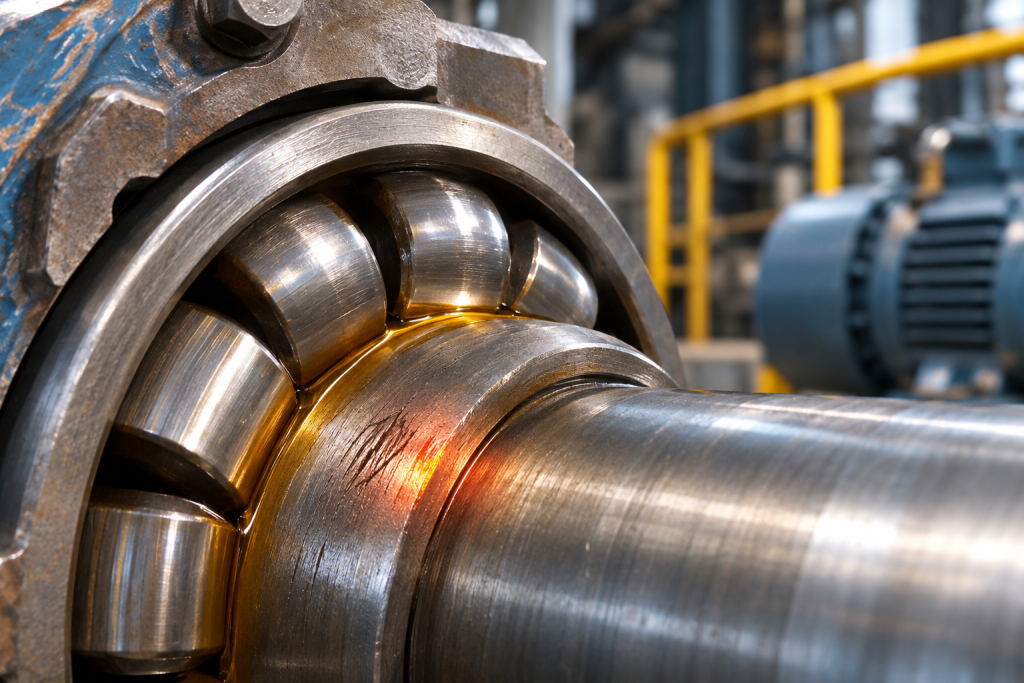
A high-quality electric motor bearing grease must deliver the correct oil viscosity at operating temperature, NLGI 2 consistency, outstanding oxidation resistance, good shear stability and a high dropping point. These characteristics maximise bearing life under continuous high-speed operation common in Malaysian industrial plants while preventing leakage and contamination.
What Viscosity and Consistency Should Electric Motor Grease Have?
Oil viscosity should match the bearing load and speed at operating temperature, typically 500–600 SUS at 100°F for mineral-oil based greases. NLGI 2 grade is the most widely used consistency because it balances pumpability with the ability to stay in place and reach all contact surfaces.
- Viscosity must form a stable lubricating film without excessive drag.
- NLGI 2 provides the firmness needed for most horizontal and vertical motors.
- Motor manufacturers often specify exact viscosity; always cross-check nameplate or manual data.
Why Is Oxidation Resistance Critical for Motor Greases?
Electric motor bearings frequently run at elevated temperatures, accelerating grease oxidation. Outstanding oxidation resistance, measured by ASTM D 3336 high-temperature grease-life testing, extends regreasing intervals and prevents hardening or varnish formation that starves the bearing of lubricant.
- Choose greases with proven long ASTM D 3336 life.
- High oxidation stability is especially valuable in Klang Valley plants where ambient temperatures and continuous duty raise bearing temperatures.
- Synthetic base oils further improve oxidation performance when longer intervals are required.
Should Electric Motor Grease Contain Extreme-Pressure Additives?
Unless the motor is mounted with a significant thrust load on the bearings, extreme-pressure (EP) additives are generally unnecessary and can actually shorten grease life. Non-EP greases are preferred for standard deep-groove ball bearings; EP greases are reserved for bearings specifically designed to carry heavy axial loads.
- EP additives may reduce oxidation stability and increase chemical aggressiveness.
- Polyurea-thickened greases such as Mobil Polyrex EM are formulated without EP chemistry for long motor life.
- Confirm bearing type and loading before selecting an EP product.
What Dropping Point and Shear Stability Are Required?
A high dropping point (approximately 500°F / 260°C or higher) prevents the grease from melting or separating under the elevated temperatures reached in electric motor bearings. Shear stability, measured by ASTM D 217 after 100 000 strokes, should limit softening to no more than 1–1.5 NLGI grades so the grease does not leak out of the housing over time.
- Lithium-complex and polyurea thickeners both deliver high dropping points suitable for motors.
- Excessive softening leads to leakage, contamination ingress and premature failure.
- Always verify shear-stability data when comparing candidate greases.
For detailed product data and local technical support in the Klang Valley, consult the Ferrovic technical information portal.
How Should Electric Motor Bearings Be Relubricated?
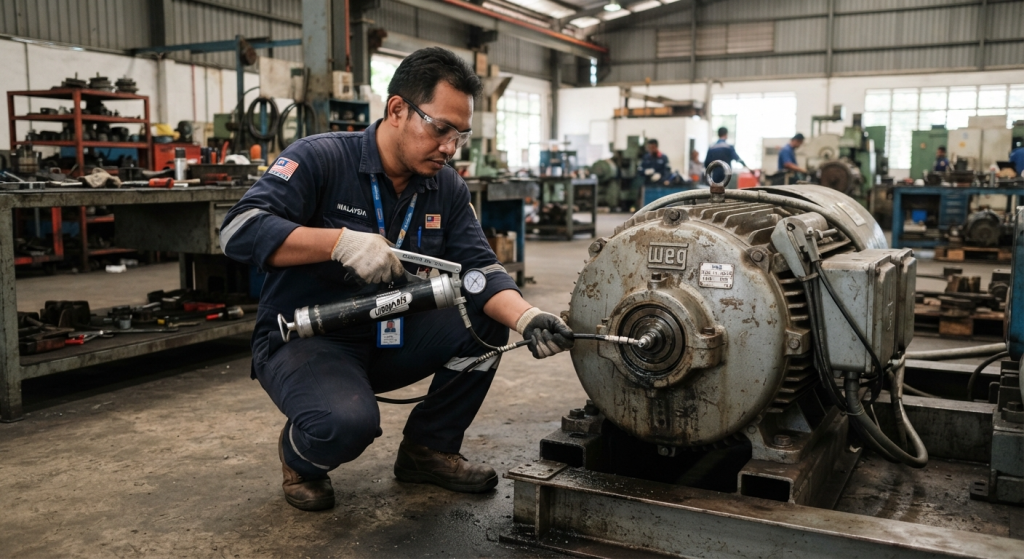
Relubrication intervals and quantities must be calculated from bearing size, speed, temperature and contamination level. Over-greasing causes overheating and lubricant migration into windings, while under-greasing leads to metal-to-metal contact and rapid wear. Proper technique and the pressure-relief method keep motors running reliably.
What Factors Determine Relubrication Frequency?
Temperature, continuity of service, bearing size and speed (Dn value), vibration, contamination and grease quality all influence how often regreasing is required. As a rule of thumb, light-to-medium-duty motors running continuously need at least annual relubrication; the interval is halved for every 10 °C rise above the recommended temperature.
- High temperature doubles the oxidation rate for every 18 °F (10 °C) above 120 °F (49 °C).
- Dn values above 150 000–200 000 demand more frequent attention.
- Vibration accelerates grease feed into the rolling elements and shortens life.
How Is the Correct Quantity of Grease Calculated?
Two practical methods are widely used. The first fills ½ to ⅔ of the free space in the bearing when speed is below 50 % of limiting speed, or ⅓ to ½ when speed is higher. The second uses the simple formula: quantity (g) = outer diameter (mm) × width (mm) × 0.005.
- Housing fill is typically kept at 30–50 % for normal speeds to avoid churning.
- Slow-speed or heavily contaminated applications may use 50–75 % fill.
- Always convert the calculated mass into the correct number of shots from a calibrated grease gun.
What Is the Correct Pressure-Relief Relubrication Procedure?
- Remove the drain plug and clean the outlet.
- Clean the grease fitting and gun nozzle.
- With the motor running and warm, pump grease until fresh grease appears at the drain.
- Continue running until excess grease is expelled, then clean and replace the drain plug.
When greasing a stopped motor, introduce only half the volume, run for 5–10 minutes at full speed, then add the remainder. This prevents over-packing and seal damage.
How Should Sealed-for-Life Bearings Be Handled?
Double-shielded or double-sealed bearings are normally lubricated for life at the factory and do not require in-service regreasing. Remove any grease fittings and plug the holes, then update maintenance records so that technicians do not attempt to lubricate them.
- Attempting to force grease into sealed bearings can rupture seals and force lubricant into the windings.
- Tag the motor clearly to prevent accidental greasing.
Authoritative guidance on grease selection for electric motor bearings is available from Mobil at this resource.
How Can Condition Monitoring Improve Motor Bearing Reliability?
Ultrasonic listening, temperature trending and standard vibration analysis detect lubrication problems long before catastrophic failure. Poor lubrication first appears in the ultrasonic range (around 30 kHz) as broadband noise; temperatures rise primarily with over-greasing or advanced damage.
What Ultrasonic Levels Indicate Under-Lubrication?
Baseline ultrasonic amplitude at 30 kHz is typically 10 dB or less. Normal lubrication produces 10–20 dB. Levels approaching or exceeding 30 dB, or a noticeable increase in crackling noise, indicate the need for immediate regreasing until the amplitude drops.
- Always take readings at the same location, axis and parameters for reliable trending.
- Position the sensor as close as possible to the bearing load zone.
When Should Temperature Be Used as a Diagnostic Tool?
Temperature is the most reliable indicator of over-lubrication. Before adding more grease to a hot bearing, investigate other causes such as blocked ventilation, misalignment, soft foot, coupling problems or electrical faults. Only after ruling out these issues should additional grease be considered.
How Should Electric Motors Be Stored to Protect Bearings?
Static corrosion and false brinelling are the two primary storage failure modes. Fully grease motors before storage, store them in a clean, dry, vibration-free location on a vibration-absorbing surface, and rotate shafts periodically to redistribute grease and maintain a protective film.
- Tag each motor with the lubrication date and grease name.
- Prefer grease cartridges in high-contamination environments.
- Align shafts carefully when returning motors to service.
Frequently Asked Questions (FAQs)
What NLGI grade is best for most electric motor bearings?
NLGI 2 is the standard recommendation because it offers the best balance of pumpability and mechanical stability for typical motor speeds and temperatures. Softer grades may leak; harder grades may not feed properly into the rolling elements.
Can different grease thickener types be mixed in a motor?
In most cases no. Different thickeners are frequently incompatible and can soften or harden dramatically, leading to leakage or starvation. Always purge as much old grease as possible and shorten the subsequent relubrication interval until the old product is fully displaced.
How often should continuously running motors in a Malaysian plant be greases?
Light-to-medium-duty motors typically require annual regreasing under moderate conditions. Halve the interval for every 10 °C above the grease’s recommended maximum temperature and increase frequency further if vibration or contamination is present.
What is the risk of over-greasing an electric motor?
Excess grease causes internal churning, rapid temperature rise, accelerated oxidation and possible migration of lubricant into the motor windings, which can damage insulation and cause electrical failure.
Where can Klang Valley maintenance teams obtain technical support for motor greases?
Local application guidance, product data and training resources are available through the Ferrovic technical information site at https://ferrovic.com/technical-info/.