
Special Properties of Engine Oils, ATF & MTF | Penrite Guide Malaysia

What Are the Special Properties Required for Engine Oils?
Engine oils must permit easy cold starts, cool critical components under heat stress, and burn cleanly to minimise combustion chamber deposits. These properties protect against the majority of wear that occurs at startup while transferring heat from bearings, pistons and timing gears back to the sump in high-ambient Malaysian conditions.
Why Must Engine Oils Permit Easy Starting?
Most engine wear occurs at start-up, so the oil requires the correct low-temperature viscosity to flow rapidly to bearings and the valve train. In modern diesel engines found in many Malaysian 4WDs, the oil also primes fuel injectors; incorrect viscosity can prevent starting entirely.
- Correct low-temperature viscosity ensures rapid oil pressure build-up.
- Low-viscosity grades are mandatory for certain common-rail diesels.
- Australian-formulated Penrite oils are selected for typical tropical ambient temperatures while still protecting at operating temperature.
How Do Engine Oils Cool the Engine?
At least 40 % of engine cooling is performed by the oil rather than the radiator system. The oil continuously absorbs heat from main bearings, big-end bearings, crankshaft, rods, timing gear and pistons before returning to the sump, placing it under constant oxidative stress.
- High thermal stability prevents rapid oxidation and viscosity increase.
- Effective heat transfer reduces local hot-spot temperatures.
- Proper additive packages neutralise acids formed during prolonged high-temperature operation common in Klang Valley stop-start traffic.
Why Must Engine Oils Reduce Combustion Chamber Deposits?
A small amount of oil always reaches the combustion chamber via cylinder walls or valve guides and is burned with the fuel. The oil must burn cleanly so that deposits do not form on valve seats or piston crowns, which can cause pre-ignition, power loss or valve-seat recession.
- Low-ash or controlled-ash formulations minimise deposit formation.
- Detergent and dispersant additives keep combustion by-products suspended until the next oil change.
- Clean-burning behaviour is especially important in turbocharged petrol and diesel engines popular in Malaysia.
For detailed technical data sheets and product recommendations tailored to Malaysian fleets, visit the Ferrovic technical information hub.
What Special Properties Do Automatic Transmission Fluids Need?
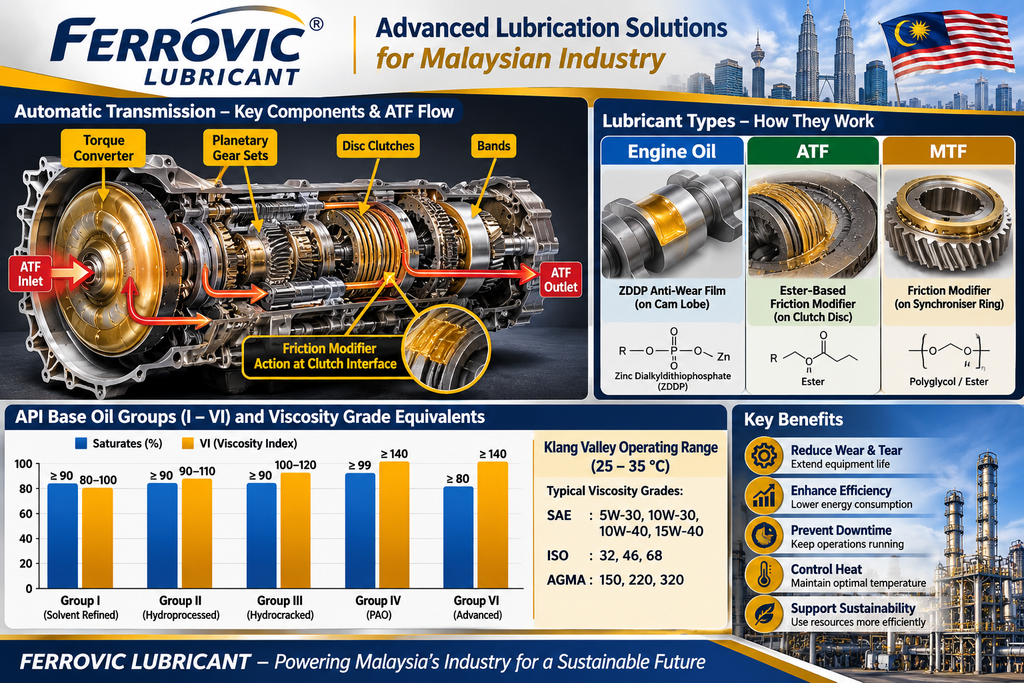
Automatic transmission fluids must act as a power-transmission medium in the torque converter, serve as hydraulic fluid for control systems, and provide precisely controlled friction for bands and clutches so that shifts remain smooth under all conditions. Friction characteristics vary by transmission manufacturer, which is why multiple ATF specifications exist.
How Does ATF Function as a Power Transmission Medium?
The fluid transmits engine torque through the torque converter without a solid mechanical connection. It must maintain stable viscosity and resist shear so that hydraulic pressure remains consistent for both power transfer and electronic control systems.
- High shear stability prevents viscosity loss during extended service.
- Correct viscosity ensures efficient torque multiplication and lock-up clutch operation.
- Thermal stability is critical in Malaysian stop-go traffic where fluid temperatures rise rapidly.
Why Is Controlled Friction Essential in ATFs?
Friction modifiers enable the bands and clutches to engage smoothly without shudder or slip. Each OEM specifies a unique friction profile; using an incorrect fluid can cause harsh shifts, delayed engagement or premature clutch wear.
- Friction characteristics must match the specific transmission design.
- Modern low-viscosity fluids (e.g., DEXRON-VI) demand tighter friction control.
- Penrite ATFs are formulated to meet the most demanding OEM friction curves rather than a generic “universal” compromise.
How Do ATFs Maintain Smooth Shifting Over the Life of the Fluid?
The fluid must retain its frictional and viscosity properties throughout the recommended drain interval. Oxidation, shear and contamination gradually alter these properties; high-quality base oils and robust additive packages delay this degradation.
- Stay-in-grade performance after severe shear testing is mandatory.
- Anti-oxidant packages extend drain intervals in hot climates.
- Compatibility with seal materials prevents leaks that would otherwise force early fluid changes.
What Special Properties Are Required for Manual Transmission Fluids?
Manual transmission fluids must deliver an easy gearshift feel for the entire oil-drain interval while maintaining long clutch life and preventing seal leaks. These properties result from the combined action of viscosity and carefully balanced friction modifiers.
How Do MTFs Provide Easy Gearshifts Throughout the Drain Interval?
Synchroniser rings rely on controlled friction between the cone and the ring to equalise shaft speeds before full engagement. The fluid’s viscosity and friction-modifier package must keep this action smooth from the first kilometre to the final kilometre of the service life.
- Correct viscosity at operating temperature prevents notchy or heavy shifts.
- Friction modifiers reduce synchroniser wear and eliminate gear clash.
- Low-temperature fluidity ensures acceptable shift quality on cool Malaysian mornings.
Why Must MTFs Protect Against Wear and Maintain Seal Compatibility?
High tooth loading and sliding contact in manual gearboxes demand anti-wear and extreme-pressure protection. At the same time the fluid must not swell or shrink seals, which would cause leaks and subsequent lubricant starvation.
- Extreme-pressure additives protect hypoid and spur gears under shock loads.
- Seal-compatible base oils and additives prevent leakage.
- Oxidation stability keeps the fluid from thickening and increasing shift effort over time.
How Do Purpose-Designed MTFs Differ from Ordinary Gear Oils?
Many older workshops still use hypoid gear oil in manual gearboxes. Purpose-designed MTFs contain specialised friction modifiers that hypoid oils lack; using the wrong fluid can produce baulking, difficult shifts or accelerated synchroniser wear.
- Dedicated MTF chemistry is optimised for brass or sintered synchronisers.
- Viscosity grades are typically lower than traditional GL-5 gear oils for better shift feel.
- Penrite MTFs are formulated specifically for smooth engagement rather than simply meeting a GL-4 or GL-5 rating.
The complete Penrite Guide to Oils and Greases remains an authoritative reference for these properties and can be accessed at the official source: Penrite Grease Guide.
Frequently Asked Questions (FAQs)
What is the most important special property of an engine oil in a hot climate like Malaysia?
Thermal stability and heat-transfer capability are critical because the oil cools approximately 40 % of the engine. Oils that resist oxidation and maintain viscosity under prolonged high sump temperatures deliver longer component life.
Can I use the same ATF in every automatic transmission?
No. Friction requirements differ between manufacturers and even between transmission generations. Always match the fluid to the OEM specification listed in the vehicle handbook or service data.
Why do some manual transmissions require a dedicated MTF instead of GL-5 gear oil?
Dedicated MTFs contain friction modifiers that optimise synchroniser performance. Standard hypoid gear oils lack these modifiers and can cause baulking or accelerated wear of the synchroniser cones.
How often should transmission fluids be changed in Malaysian operating conditions?
Severe duty (stop-start traffic, high ambient temperatures, frequent short trips) typically halves the normal drain interval. Follow the severe-service schedule in the owner’s manual and monitor fluid condition.
Where can Malaysian workshops obtain technical data for Penrite lubricants?
Detailed product data, specifications and application guides are available through the Ferrovic technical information portal at https://ferrovic.com/technical-info/.